The 2013 Save Green Expo is scheduled for Saturday, September 14th from 9 am to 3 pm. The location is the Crossroads Institute, 1117 East Stuart Drive (Rt. 58 east of Galax just before WalMart Plaza).
This year’s theme is
“Prepared Today = Ready Tomorrow.”
Displays will focus on how to be more self-sufficient - as individuals, households, and communities. Much of our area is sparsely settled, with some homes quite isolated. Every household needs to be prepared to handle food, water and shelter in cases of extreme weather and power outages. There are many simple, inexpensive suggestions that can be implemented quickly, as well as, more long- term solutions, such as solar power which requires more of an investment.
Grayson LandCare is seeking vendors that will add to our understanding of this subject.
Please see the following vendor application if you are interested.
And be sure to put this on your calendar and plan to be there!
Grayson LandCare is pleased to invite your participation
in our annual SAVE GREEN EXPO
to be held this year at Crossroads Institute in Galax,
Virginia on Saturday, September 14, 2013, 9 am - 3 pm.
This year, we are focusing on being prepared, as individuals and communities, for unexpected events such as extreme weather. Power outages, food and water, telecommunications, safety and other relevant topics will be featured, with practical ideas and solutions. There will be a variety of vendors and displays, with special activities for kids, door prizes, live music and food vendors on site. This event is free and open to the public and is widely publicized throughout the region.
We look forward to your participation in this year's SAVE GREEN EXPO sponsored by Grayson LandCare, a 501(c)(3), non-profit, grassroots organization. LandCare is a democratic approach to community development seeking the triple bottom line: Increased incomes, improved community services, and protection of our natural resources. Please visit our website for more information about our organization.
Danny Boyer,
President of Grayson LandCare,
was awarded the
2013 Outstanding Forage
Producer of the Year
through the
Virginia Forage and Grassland Council (VFGC).
He was recognized for the award during
this past month’s
Virginia Forage and Grassland Council
Winter Conference series,
which was co-sponsored by
Virginia Cooperative Extension.
Danny leads one of the VBFRCP’s
Whole Farm Planning teams in the
far southwest region.
It may be January, but there are big changes happening at the Independence Farmers Market. Due to the hard work of Rick Cavey and other supporters of the market, a grant was awarded to fund a paid manager position and host several workshops aimed at increasing both vendor and consumer participation in the market. Michelle Pridgen is the new manager.
Michelle has an associate degree in general agriculture from NC State University. After graduating, she worked as a horticultural technician at NC State for Doug Sanders a research and extension professor of vegetable crops specializing in tomatoes, peppers, asparagus and watermelons. Having grown and marketed cutflowers and dried flower wreaths for the Roanoke farmers market in the 90’s, she knows that crafts are a valuable addition to the mix of products. Michelle is an avid gardener, raises a few chickens and is thrilled to have the chance to promote the wide array of fresh food and local crafts available at the Independence farmers market.
Plans for workshops sponsored by the market are being finalized this month. Extension agents and local producers will share their knowledge about season extension, successive planting, marketing, farm planning, value-added products, beekeeping, canning, recipes and more. Also in the works long term are improvements to the site including permanent market structures, a stage for events and a play area.
Anyone interested in selling produce, flowers, meats, baked goods or crafts is encouraged to contact Michelle at 276-655-4045 or independencefarmersmarket@gmail.com . Check this site for dates of the workshops and vendor applications.
Everyone involved with the Independence Farmers Market is looking forward to a great market season and we invite you all to join us May 10th for our grand opening. Market hours are 9am-1pm Fridays and 4pm to 6pm Wednesdays.
Encore.org announced that Jerry Moles, the founder of GraysonLandCare, was chosen as a 2012 Purpose Prize fellow.
The Purpose Prize is the nation’s only large-scale investment in social entrepreneurs and other creative problem solvers in the second-half of life.
Jerry was named a fellow because of his introduction of Landcare into Southwestern Virginia. Through Landcare, a collaboration of farmers, landowners, and residents from Grayson, Carroll, Floyd and Ashe counties are working to develop sustainable, local, agricultural businesses.
Jerry Moles
“Purpose Prize fellows are using their passion and experience to help solve some of society’s steepest challenges,” said Marc Freedman, founder and CEO of Encore.org and author of The Big Shift. “They represent a growing wave of people in their 60s and beyond who are using their knowhow to change the world, while shifting perceptions of what is possible in this stage of life.”
The Purpose Prize program is funded by the John Templeton Foundation and The Atlantic Philanthropies. The Prize is awarded by Encore.org (the new name for Civic Ventures), a nonprofit that promotes encore careers – work that is both personally meaningful and serves the greater good.
“While being back in Virginia was a change in scenery, I’ve simply continued what I’ve done for much of my life in Sri Lanka, Northern California, Guatemala, and elsewhere. Returning home and discovering the gifted and energetic rural leadership along the Blue Ridge Plateau (Grayson, Carroll, and Floyd counties), the task was simply sitting with people and discovering consensus about shared needs and how these needs could be best met. Many have contributed to the realization of dreams including SustainFloyd, Virginia Tech Colleges of Natural Resources & Environment and Agriculture & Life Sciences, Virginia Farm Bureau, USDA Natural Resource Conservation Service, Appalachian Regional Commission, Virginia Tobacco Commission, National Fish & Wildlife Foundation, Virginia Department of Agriculture & Consumer Services, the Claire B. and James M. Matthews Foundation, and many, many others who have given time and money.”
A panel of 23 judges – leaders in business, politics, journalism and the nonprofit sector – chose the five winners from a pool of more than 800 nominees. This year’s 35 fellows are finalists for The Prize. An awards ceremony will be held in February in San Francisco. For more information about The Purpose Prize, visit: www.encore.org/prize.
About Encore.org (www.encore.org)
Encore.org is a nonprofit organization building a movement to make it easier for millions of people to pursue “encore careers” – second acts for the greater good. The Purpose Prize, funded by the John Templeton Foundation and The Atlantic Philanthropies, is a program of Encore.org.
About Grayson LandCare, Inc. (www.graysonlandcare.org)
Grayson LandCare is a locally organized group of farmers, landowners, and residents concerned about economic and environmental challenges in Grayson County and southwest Virginia. Grayson County has historically been a rural agricultural community based on small town values and the unique cultural identity of our beautiful Appalachian landscape but rising land prices, higher property taxes, and competition from corporate farming threaten to overcome family farms, fragment landscapes, and destroy our rural way of life.
Orchards of Hope:
High School Students Plant Trees
on Food Day
Orchards of Hope brings fruit trees into public spaces, school grounds, county parks and wellness centers in Alleghany County, NC. This project enables residents of the community to pick and consume fresh fruit. In honor of National Food Day, the Appalachian Agriculture Coalition led high school students in planting fruit trees at the Moxley Road Community Garden site.
This year, nearly 8,000 farmers markets have connected farmers to consumers across the United States. That’s double the number from a decade ago, and it’s a number that depends on an increasing nationwide preference for fresh food. In fact, 68 per cent of Americans say they eat more fresh food than they did five years ago, according to a study from the W.K. Kellogg Foundation. For many, the source of much of that food—and perhaps the source of that shift in habits—is a local farmers market.
Yet despite this broad movement toward a different kind of eating, ... Continued - click here!
Transformations
The Virginia Tech College of Natural Resources and Grayson LandCare: Discovery/Creation of Sustainable Ways of Life and Leadership for the Future
The question “what shall we do about it?”
is only asked by those who do not
understand
the problem.
If a problem can be solved at all,
to understand it and to know what to do about it
are the same thing.
(Watts, 75)
I. The Challenge
In the face of unprecedented environmental, economic, and social changes, too frequently our understandings and responses fail to achieve desired and necessary results. A lack of clarity about how to keep up with the dynamic of the present, much less step confidently into the future, has left communities, commercial enterprises, states, and nations confused. Often they are badly divided as to the nature of the forces contributing to their distresses and about potential remedies that might offer relief.
Discovering what must be done in each locale to achieve sustainable, resilient landscapes, watersheds, communities, businesses, and governments is only half the challenge. Finding ways to implement necessary and beneficial change at sufficient scale and to sustain it through time is work that must engage all present and future generations. Virginia Tech has an important and exciting opportunity/responsibility for leadership in exploration of existing and emergent needs and the means to meet them.
For a major land grant university like Virginia Tech, the challenge is complicated. Institutions of higher learning have specific momentum as a result of having succeeded in devising improved understandings, technologies, and management systems with tight focus on a limited number of interests. Investment in research and development by discipline has been rewarded as a result of success in expanding our understandings of new worlds unanticipated and unimagined just a few short years ago. Genetic engineering, nanotechnology, information technology, sub-atomic physics, and marketing have increased human capacity to manipulate the physical world, living biomass, and behavior. Recognition and financial rewards have followed. More of the same is anticipated.
Yet out beyond these successes remains a larger world where other pressing problems are not being resolved or even addressed. Water is becoming an increasingly scarce resource. Soil losses in some places have dramatically reduced the potential for food, fiber, fuel, and forage production. Where people and opportunities don’t meet in the same time and place, standards of living have fallen or remained stagnant. Financial returns to agriculture and forestry minimally support a majority of those living on the land, if at all. The growth of human populations and the restless migrations away from scarcity mean that the global community is becoming “unsettled” on a scale unimaginable fifty years ago.
II. The Academic Community
In order to study a phenomenon, there must be some degree of control over the subject of inquiry or else cause and effect will not be understood and findings will be open to question. In the physical sciences, control within laboratories and in the world of sticks and stones is relatively easy to achieve. On the other hand, when the inquiry concerns complex and dynamic living systems responding to a wide range of stimuli, control is progressively difficult for practical and often ethical reasons. While the cell on a glass slide under the microscope can do little other than be observed, understanding the impact of climate change on different tropic levels in a temperate forest is quite a different matter. Do we investigate soil microorganisms exchanging minerals for sugars with trees, precipitation in relation to changes in temperatures, biodiversity in response to changes in vegetation cover, the management practices of landowners, changes in the availability of forest products, melting ice in the Arctic, or all of the above? Even if we study all of the above, how is the information to be packaged into some comprehensible whole?
In science, we often read that some finding is true, ceteris paribus, or said another way, all other things being equal or held constant. As complexity increases, as questions are asked about cause and effect beyond the laboratory, the physical world, and simple life forms, all other things are less likely to be equal or even to be known.
When there is less control, the ability to predict or anticipate consequence is reduced because there are unaccounted variables that influence outcomes. For the economist, these are the externalities that exist beyond the focus of classical theories and methods of inquiry. For the ecologist, such variables are beyond the systems of interest that have been carefully delineated. As consideration is further expanded to include the fields and forests, the streams and rivers, and the human beings that manage the land and influence what is grown, harvested, processed, and delivered, each discipline has a stake in any proposed action with only a partial view of the whole. The various disciplinary practitioners may speak different technical languages, and use different information collection techniques, and their focuses often don’t overlap or correlate even though they may investigate phenomena that are interrelated and mutually influential if not mutually dependent.
The British philosopher Alfred North Whitehead (1920) commented that nature is infinitely divisible, i.e., there are an infinite number of ways of seeing nature. Any “complete” description is beyond our capacities, as the ecologist Frank Egler noted: "Ecosystems not only are more complex than we think, but more complex than we can think" (Noss, O'Connell, and Murphy: 1997:76). As a consequence, while many discipline-oriented researchers are raising questions concerning the long-term viability of existing biodiversity, water quality, and supplies of food, fuel, fiber, and forage, too frequently their conclusions are difficult to apply to the findings produced by other disciplinarians or to new technologies and management techniques. If problems are identified and solutions offered separately -- one at a time -- to improve water quality, increase forage yields, improve timber management, increase income to landowners...
April 11, 2012 - PotomacLocal.com
By Ashley McLeod
Capital News Service
RICHMOND, Va. – Beekeepers across Virginia soon will be able to get government money for creating new beehives – a move legislators hope will resurrect the state’s dying bee population.
During this year’s regular session, the General Assembly passed legislation to establish a $175,000 fund and award beekeepers as much as $200 for every new beehive, up to $2,400. Gov. Bob McDonnell recently signed the two bills, SB 354 and HB 300, into law.
Sen. Creigh Deeds, D-Charlottesville, sponsored the Senate bill. He hopes the money will encourage beekeepers to create more beehives.
“We’ve seen declining bee populations throughout Virginia, and they are the foundation of agriculture,” Deeds said. “If they’re not pollinating flowers and plants, crop production begins to lag.”
State apiarist Keith Tignor is responsible for educating and training beekeepers in Virginia. Tignor said his office has received numerous phone calls from Virginia beekeepers interested in the grant program.
“We estimate that there are between 20,000 and 30,000 beehives in Virginia, around 2,000 to 3,000 beekeepers, and most maintain an average of between 10 and 12 hives,” Tignor said. “Beekeeping is a very important part of Virginia, in many different aspects.”
Delegate Ed Scott, R-Culpeper, agreed. He proposed the House bill creating the grant program.
“There are a wide range of benefits to having a healthy bee population – not just for honey production,” Scott said.
“When bees pollinate other crops, they are stimulating agricultural production in a wide range of areas, anywhere from apple and peach orchards, to grapes and alfalfa hay crops. If we didn’t have beekeeping, we wouldn’t have other crops being as successful as they are.”
Deeds and Scott introduced their bills after judging a student competition conducted last summer at the Sorensen Institute’s College Leaders Program at the University of Virginia. The lawmakers were inspired by a group of college students who had drafted mock legislation aimed at addressing the state’s declining bee population.
Similar bills failed in previous years. The legislation, which will go into effect July 1, was initially introduced as a tax credit but was changed to a grant program by a legislative committee.
Beekeepers must apply for the grants, which will be administered by the Virginia Department of Agriculture and Consumer Services.
Palmer Fant, member of the Grayson County Planning Commission, urges all Grayson residents to take the planning survey.
This is important! All residents need to give their input in order for the plan to reflect your wishes. If you did not receive it in the mail, you can complete it here: http://www.plangrayson.com.
Please pass this along to your neighbors and friends.
We need your help with:
The Save Green Expo planning team. Contact Loren Webster at lorenwebster@embarqmail.com or reply here to me if you are interested. The next meeting is March 13th at 11 am in the 1908 conference room. As we get closer to September, we will need lots of volunteers that week and especially on 9/14. Please put that date on your calendar!
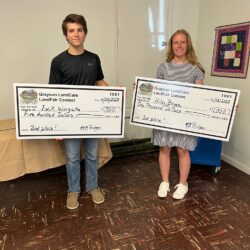
The Land Stewardship Contest will be held on Saturday, April 13th. Ruth Ross needs all of us to seek donors for prize money; she has a standard letter you can use to approach businesses you know and frequent. Also, we will need people on Friday the 12th for set-up and on Saturday the 13th to manage the contest. Contact Ruth at ross@ls.net.
The Livestock Committee is being revived by Colette Nester. If you have an interest in raising any type of livestock for consumption and/or sale, please consider joining this committee and e-mail colette at crosscreekfarm@hotmail.com.
The Independence Farmers Market has a committee that plans special events as well as regular market activities. Contact Michelle Pridgen at independencefarmersmarket@gmail.com.
We need a Program Committee to plan our meetings so they aren't just business meetings but have a guest speaker or focused discussion. Please reply to me here (kathycole1@live.com) if you could help with this task.
If you want to work on raising capital to build the regional slaughterhouse, please contact Jerry Moles at jmoles@igc.org for more information.
Thank youand please get involved in one of our ongoing projects to improve this great place we call home!
CLICK HERE FOR FULL SIZE MAP President's report (1-2)
Celebrate with us…the year of the farmer (3-4)
Brian story…and Will's story… (5-6)
Ian's story… (7-8)
Wind Farming (9)
It's Ragwort time again… (10)
Snippets! (11)
SLWG (11)
Defeating boneseed (12)
Contribute a newsletter article (13)
Stop Press… (13)
Happy Christmas & New Year Cheer (13)
Victorian Landcare and Catchment Management Magazine - Latest Issue #56
This issue is a feature on international Landcare and includes stories on the application of Landcare principles and practice in countries such as Indonesia, New Zealand, Tonga, Germany, and Uganda. These stories provide insights into how international communities have adapted Landcare to suit their cultures, landscapes and natural resource management priorities.
Inspired by and building upon Heifer International's 65 years of community development experience, the Seeds of Change Initiative is a campaign to grow jobs, improve health, and end American poverty through the extraordinary potential of locally grown food.
This is possible thanks to the potential of capable people who want to work--to start or rejuvenate small farms, create innovative food-based businesses, and connect to existing viable markets while also developing new ones.
Capitalizing on the current local food movement, Seeds of Change will help low-income Americans become fully engaged participants in the momentum of these increasingly popular initiatives -- both as qualified providers of high quality food and knowledgeable consumers of it.
The USDA Farmers Market Promotion Program awards $26,488 to Grayson LandCare, Inc., Independence, VA, to professionalize
the Independence Farmers Market with a permanent market
manager and Board of Directors and to promote it as a viable,
self‐sustaining retail outlet for local growers and a venue for
consumers to buy
local fresh produce, meats, and eggs.
We were one of only five markets in Virginia to receive an award. Thank-you Grayson LandCare for all you did to make this possible!
Rick Cavey
Independence Farmers’ Market Manager
Are you up to the challenge?
We need your help to spread the word.
Would you take a moment to share this exciting initiative by distributing this link to
your friends and family? http://virginiafood.org/10-a-week/
Let’s get this fun and easy challenge off to
a great start!
Together we can build our local economy by supporting Virginia farmers!
"Every time you sit down to a meal, you're voting on what kind of agriculture you want."
Watch this 5-minute film on Nebraska meat producers who put the needs of the soil and the animals first--and are finding that consumers respond, making their techniques MORE profitable while they feel good about what they are doing.
World's first online radio station dedicated to music with an environmental message
Hi Friends from Joyce Rouse,
The New Year began with a dream come true for some dear friends of mine with MUSE (Musicians United to Sustain the Environment). We started the world's first online radio station dedicated to music with an environmental message. I'm sending out this news blast especially to share some updates about this project and invite you to tune in to Earthday.fm.
Earthday.fm features a full-spectrum of music spanning six decades and many genres. Imagine my surprise to have Earth Mama songs programmed alongside the music of Tracy Chapman, John Hall, and George Harrison. The playlist draws from 5,000 songs with environmental and indigenous lyrics. The diversity is truly inspiring. Already, this station has attracted more than 300 listeners from 25 countries. You can help by becoming a listener and also inviting your friends to listen.
To tune in, go to: http://www.live365.com/stations/earthdayfm. The radio stream is free and will work with any audio player on your computer. And, more big news is coming. In March, MUSE will be launching weboflife.fm, dedicated to music specially programed for children and families.
Here are some more simple ways that you can be involved:
For station updates, please sign up for Earth Song eNews by clicking here.
If you have a website and would like to simulcast this station on your website (for free), please let us know and we will send you the instructions to do so.
Be a song angel and help the station by purchasing more songs (from hard to reach recording artists) for the playlist. To gift a song to Earthday Radio, click here to see our Amazon wish list. Click on the song that you want to contribute, then select Give Song As a Gift.
The Claire B. and James M. Matthews Foundation has awarded $47,080 per year for five years to Virginia Tech's College of Agriculture & Life Sciences and Cooperative Extension. This grant will fund an experiment in whole-farm planning in Grayson County. Danny Boyer, local farmer and President of Grayson LandCare, is the Principal Investigator working with three farms in Spring Valley. Virginia Tech will offer assessment and planning expertise and measurement of results.
Whole farm planning, first developed in Australia through the LandCare movement, enables farmers to balance farm profitability, community benefits, and environmental health. With the support of agriculture and forestry specialists, farmers and other landowners learn to integrate their management approaches recognizing their financial, community, and environmental goals. Given needs of their families (health, education, retirement), existing farm resources are evaluated – soils, water, lay of the land, livestock, buildings, equipment, labor availability, etc. – to determine options given the availability of markets, technical advice, investment capital, collaborative community ventures, e.g., Grayson Natural Foods, and other resources and services. From this evaluation, a farm plan is developed. At this stage, it becomes possible to identify the missing elements in what the farmer would like to achieve on the farm. Focusing on the farmers, people from Tech Cooperative Extension and the Colleges of Natural Resources & Environment and of Agriculture & Life Sciences, Farm Bureau, and the Virginia Departments of Agriculture & Consumer Services and of Forestry supporting the whole farm planning effort work together to create and implement plans that will improve farm incomes, protect water supplies, and contribute to a healthy community and environment. As plans are put into action, progress is periodically monitored to adapt the plan to changing circumstances, both on the farm. in markets, and with collaborating neighbors and other partners.
From the broader landscape and watershed perspective, whole farm planning is sensitive to the holdings of individual farmers and other land owners and the flows of energy, water, wildlife, information, capital, etc. From the perspectives of the community, universities, and other cooperating agencies and organizations interested in environmental services, endangered species, stream quality, etc., each individual farm can be located in relation to these flows. Management regimes can be designed to take financial advantage of specific locations while protecting environmental services and native biodiversity. This requires landscape and watershed evaluation for the design and later for the evaluation of the whole farm planning effort.
In Short Supply:
Small Farmers and the Struggle to Deliver Healthy Food
o Your Plate
The American food system doesn't make it easy for small farmers to get their healthy food to your home, but meet two farmers in Scott County, VA who are trying: Ricky Horton and Sherilyn Shepard. They're siblings who grow tomatoes, cucumbers, and other vegetables in southwestern Virginia. Their livelihood is filled with uncertainties ranging from unpredictable weather to changing immigration laws. This is their story.